UPESSC Assistant Professor English Study Plan 2026
The UPESSC Assistant Professor English examination requires a balanced combination of literary knowledge, conceptual understanding, General Knowledge and examination practice. Follow the 20-day study plan, revise the prescribed texts, practise MCQs regularly and analyse your performance. Most importantly, use the latest official syllabus as your preparation checklist.

UPESSC Assistant Professor English Study Plan 2026: 20-Day Preparation Strategy
Preparing for the UPESSC Assistant Professor English Exam 2026 requires a focused strategy, strong command of English literature, and consistent mock-test practice. With a vast syllabus covering British literature, American literature, Indian writing in English, literary criticism, linguistics and new literatures, candidates must prioritise revision instead of trying to study everything from scratch.
This 20-day study plan is designed to help candidates organise their preparation, revise important literary works, strengthen conceptual understanding and improve accuracy before the examination.
Whether you are preparing for the first time or revising after UGC NET or SET preparation, this timetable can help you use your remaining preparation time effectively.
UPESSC Assistant Professor English Exam Pattern 2026
Before following a study plan, understand the examination structure.
| Particulars | Details |
|---|---|
| Recruiting body | Uttar Pradesh Education Service Selection Commission (UPESSC) |
| Post | Assistant Professor – English |
| Exam dates | 19–20 November 2026 (reported schedule; verify official notice) |
| Question type | Objective-type MCQs |
| Total questions | 120 |
| General Knowledge | 30 questions |
| English subject | 90 questions |
| Written examination marks | 360 |
| Duration | 2 hours |
| Correct answer | +3 marks |
| Incorrect answer | -1 mark |
| Interview | 40 marks |
The English subject section carries 270 out of 360 written marks. Therefore, candidates should dedicate most of their study time to English literature and language-related topics while maintaining regular General Knowledge revision.
Always check the latest notification and syllabus on the official UPESSC website before finalising your preparation.
Understand the UPESSC Assistant Professor English Syllabus
The English syllabus covers multiple periods, literary movements, authors, texts and language concepts. Organise your preparation around the exact units and prescribed texts in the current official syllabus PDF.
Your revision checklist should include these broad areas:
1. History of English Literature and Literary Movements
Renaissance and Reformation
Elizabethan and Jacobean periods
Restoration and Neoclassical literature
Romantic and Victorian periods
Modernism and Postmodernism
Major literary movements, forms and genres
2. British Literature
British poetry and major poets
British drama and playwrights
British prose and essays
British fiction and novels
Important literary periods and their characteristics
Prescribed authors, texts and characters
3. Literary Theory and Criticism
Classical literary criticism
Aristotle and Plato
Romantic criticism
New Criticism
Structuralism and Post-Structuralism
Marxist criticism
Feminist criticism
Psychoanalytic criticism
Postcolonial criticism
Reader-response theory
Indian poetics, including Rasa and Dhvani
4. American Literature
Major American poets
American drama
American fiction
Transcendentalism
Modern American literature
Major writers and their prescribed works
5. Indian Writing in English
Early Indian writing in English
Rabindranath Tagore
Toru Dutt
Sarojini Naidu
R. K. Narayan
Mulk Raj Anand
Raja Rao
Nissim Ezekiel
Kamala Das
A. K. Ramanujan
Contemporary Indian English writers
6. Linguistics, Phonetics and Modern Grammar
Properties of human language
Saussure's linguistic concepts
Phonetics and phonology
Phonemes and speech mechanisms
Morphology and syntax
Generative grammar
Sociolinguistics
Stylistics and discourse analysis
English Language Teaching (ELT)
7. New Literatures in English
African literature
Canadian literature
Australian literature
New Zealand literature
Caribbean literature
Postcolonial writers and texts
Important: This is a topic-organising checklist, not a replacement for the official subject syllabus. Follow the prescribed authors and texts in the current UPESSC English syllabus.
20-Day UPESSC Assistant Professor English Study Plan
The following timetable is designed for candidates who have already studied the subject and need structured revision before the examination.
Week 1: British Literature and Literary History
| Day | Topics to revise | Practice target |
|---|---|---|
| Day 1 | Renaissance, Reformation, Elizabethan and Jacobean periods | 40 MCQs |
| Day 2 | Restoration, Neoclassical and Augustan literature | 40 MCQs |
| Day 3 | Romantic literature and major Romantic poets | 50 MCQs |
| Day 4 | Victorian literature, poets and novelists | 50 MCQs |
| Day 5 | Modernism, Postmodernism and literary movements | 50 MCQs |
| Day 6 | British drama: playwrights, plays and characters | 60 MCQs |
| Day 7 | British poetry, prose and fiction revision | 1 sectional mock test |
Week 1 goal: Build a clear timeline of English literary history. Remember authors, periods, major works, genres and important literary characteristics.
Week 2: Criticism, American and Indian Literature
| Day | Topics to revise | Practice target |
|---|---|---|
| Day 8 | Classical criticism: Plato, Aristotle and Horace | 50 MCQs |
| Day 9 | Romantic, Victorian and modern criticism | 50 MCQs |
| Day 10 | Structuralism, Marxism, Feminism and Postcolonialism | 60 MCQs |
| Day 11 | Indian poetics: Rasa, Dhvani and major concepts | 50 MCQs |
| Day 12 | American poetry and major poets | 50 MCQs |
| Day 13 | American drama, fiction and prose | 50 MCQs |
| Day 14 | Indian Writing in English and prescribed texts | 1 sectional mock test |
Week 2 goal: Revise important critics, theoretical concepts, writers, works and literary movements. Create short comparison notes for similar theories and authors.
Week 3: Linguistics, New Literatures and Final Revision
| Day | Topics to revise | Practice target |
|---|---|---|
| Day 15 | Linguistics, Saussure and language concepts | 50 MCQs |
| Day 16 | Phonetics, phonology, morphology and syntax | 50 MCQs |
| Day 17 | ELT, sociolinguistics, stylistics and discourse analysis | 50 MCQs |
| Day 18 | African, Canadian, Australian and Caribbean literature | 60 MCQs |
| Day 19 | Complete English syllabus revision and weak topics | 1 full-length mock test |
| Day 20 | Final revision, important facts and error notebook | 1 final mock test |
Week 3 goal: Complete the remaining topics, revise short notes and practise under examination conditions.
Daily Study Timetable for UPESSC English
A consistent daily routine is more useful than studying for long hours without a plan.
| Study session | Time | Activity |
|---|---|---|
| Session 1 | 2 hours | English literature and prescribed texts |
| Session 2 | 1 hour | Literary criticism and theory |
| Session 3 | 1 hour | Linguistics, grammar or language topics |
| Session 4 | 1 hour | General Knowledge and current affairs |
| Session 5 | 1 hour | MCQ practice and mock-test analysis |
| Session 6 | 30 minutes | Quick revision and error notebook |
Total: Approximately 6.5 hours daily.
Candidates with less available time can shorten the sessions, but should retain daily MCQ practice and revision.
General Knowledge Preparation Strategy
The General Knowledge section contains 30 questions, so it should not be ignored even though English carries greater weightage.
Focus on:
Current national and international events.
Indian history and the freedom movement.
Indian geography.
Indian Constitution and polity.
Indian economy and basic economic concepts.
Science and technology.
People and environment.
Teaching and research aptitude.
Information and Communication Technology.
Higher education and the role of UGC.
Prepare concise notes and revise them regularly. Avoid spending too much time on low-priority details that are not included in the prescribed syllabus.
How to Prepare English Literature Effectively
1. Create an Author–Work–Period Notebook
Prepare a separate notebook containing:
Author's name
Literary period
Major works
Genre
Important characters
Literary contributions
Important quotations or concepts where relevant
This makes factual revision easier.
2. Prepare Literary Timelines
Arrange major writers chronologically. Learn the literary periods, important movements and the historical background of each period.
3. Revise Literary Criticism Through Comparisons
Create comparison tables for concepts such as:
Plato vs Aristotle
Romantic criticism vs Neoclassical criticism
Structuralism vs Post-Structuralism
Marxism vs Feminism
Formalism vs New Criticism
Rasa vs Dhvani
Understanding the differences can help you solve conceptual MCQs.
4. Practise Questions After Every Topic
Do not wait until the entire syllabus is complete. Solve topic-wise questions immediately after revising a unit.
Explore MockHubs for mock-test and exam-preparation resources, and use your practice sessions to identify topics that need more revision.
Mock Test Strategy for UPESSC Assistant Professor English
Mock tests should be an essential part of your final preparation.
Follow this approach:
Start with topic-wise MCQs.
Attempt sectional tests after completing major syllabus areas.
Take full-length tests using the actual two-hour time limit.
Analyse every incorrect answer.
Revise the concepts behind your mistakes.
Repeat questions from weak areas after a few days.
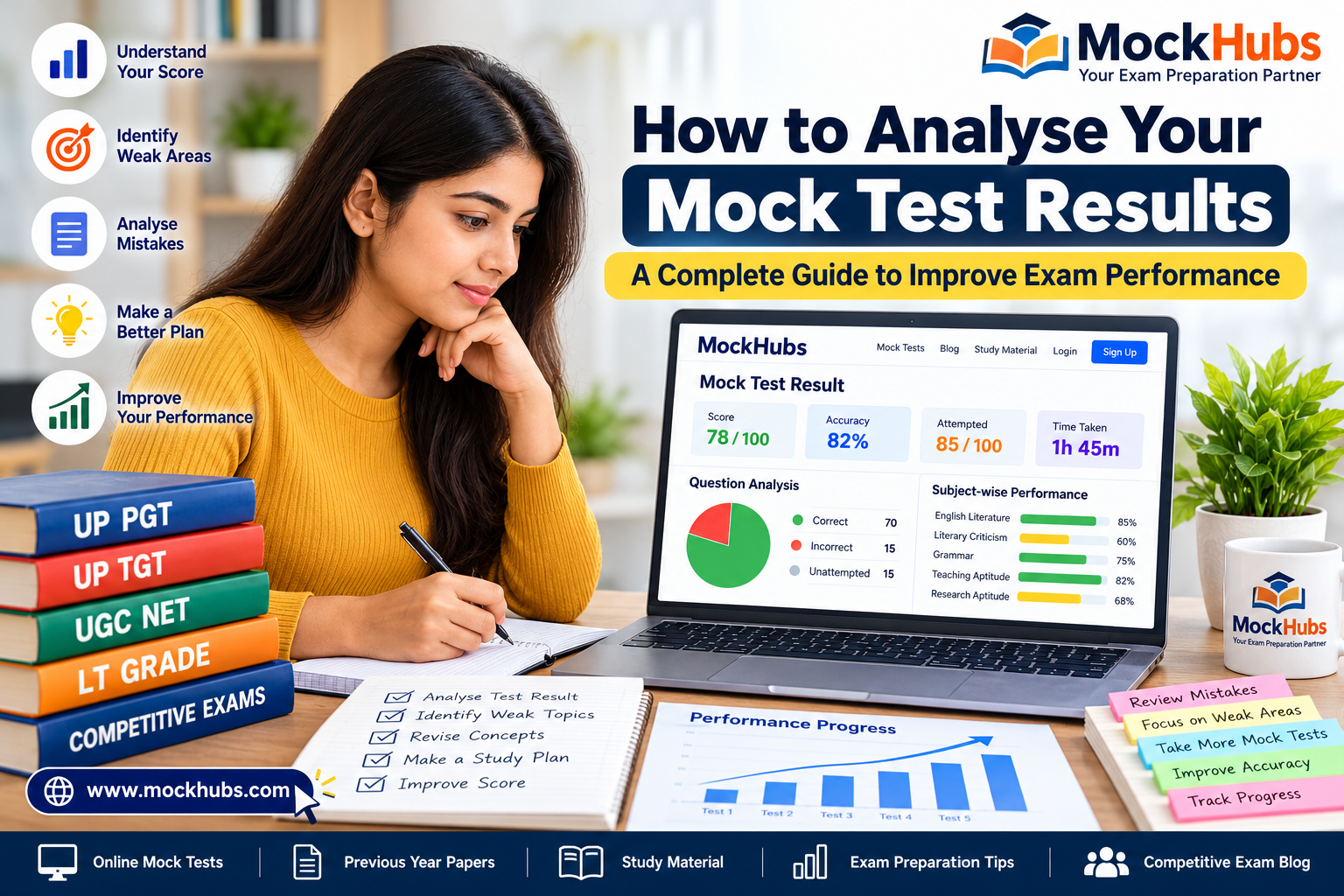
How to Analyse Your Mock Test Results
After every test, record:
Total attempted questions
Correct answers
Incorrect answers
Unattempted questions
Accuracy percentage
Topics with the most errors
Time spent on difficult questions
Because the reported marking scheme includes negative marking, accuracy is important. Avoid random guessing and develop a question-selection strategy through timed practice.
Last 3 Days Revision Strategy
Use the final three days to consolidate your preparation rather than starting large new topics.
Day 1:
Revise British literature and literary history.
Review authors, works, periods and literary movements.
Practise selected English MCQs.
Day 2:
Revise literary criticism, Indian and American literature.
Review linguistics and new literatures.
Revisit your error notebook.
Day 3:
Revise short notes and important facts.
Review General Knowledge.
Check examination instructions and required documents.
Avoid exhausting yourself with a long, late-night study session.
Common Mistakes to Avoid
Studying without checking the current official syllabus.
Spending too much time on only British literature.
Ignoring linguistics and literary criticism.
Neglecting General Knowledge.
Memorising authors without connecting them to their works and periods.
Taking mock tests without analysing mistakes.
Making random guesses despite negative marking.
Starting too many new books during the final revision period.
Best Preparation Strategy: Study, Practise and Analyse
A successful preparation strategy should combine three activities:
Study: Understand literary periods, writers, prescribed texts and language concepts.
Practise: Solve topic-wise MCQs and timed mock tests regularly.
Analyse: Identify weak areas, correct mistakes and revise them repeatedly.
Candidates can explore MockHubs – Online Mock Tests and Exam Preparation to support their preparation with structured practice and self-assessment.
Frequently Asked Questions (FAQs)
1. How many questions are asked in the UPESSC Assistant Professor English exam?
The reported 2026 written examination pattern includes 120 objective questions: 30 General Knowledge questions and 90 questions from the concerned subject.
2. How many marks are allocated to English?
The English subject section carries 270 marks, with 90 questions carrying 3 marks each.
3. Is there negative marking in the UPESSC Assistant Professor exam?
The reported 2026 pattern provides a deduction of 1 mark for each incorrect answer. Candidates should verify the marking scheme in the official notification.
4. How many days are required for final revision?
This article provides a 20-day revision plan for candidates who have already covered the core syllabus. Beginners may need a longer preparation period.
5. Which topics should be prioritised in English?
Prioritise the prescribed syllabus, including British literature, literary history, literary criticism, American literature, Indian Writing in English, linguistics and New Literatures in English.
6. Should candidates practise mock tests daily?
Yes. Regular practice helps improve accuracy, time management and familiarity with objective-type questions. Analyse each test instead of focusing only on the score.
Final Words
The UPESSC Assistant Professor English examination requires a balanced combination of literary knowledge, conceptual understanding, General Knowledge and examination practice.
Follow the 20-day study plan, revise the prescribed texts, practise MCQs regularly and analyse your performance. Most importantly, use the latest official syllabus as your preparation checklist.
Start your preparation today with MockHubs and move one step closer to your Assistant Professor goal.
Explore: https://mockhubs.com/
Put this into practice
Take a full-length, exam-pattern mock test in English or Hindi and see your topic-wise report in minutes.
Take a free mock test Browse exams