How to Analyse Your Mock Test Results
How to Analyse Your Mock Test Results: A Complete Guide to Improve Exam Performance Preparing for competitive examinations requires more than reading books, memorising concepts and solving practice questions. One of the…
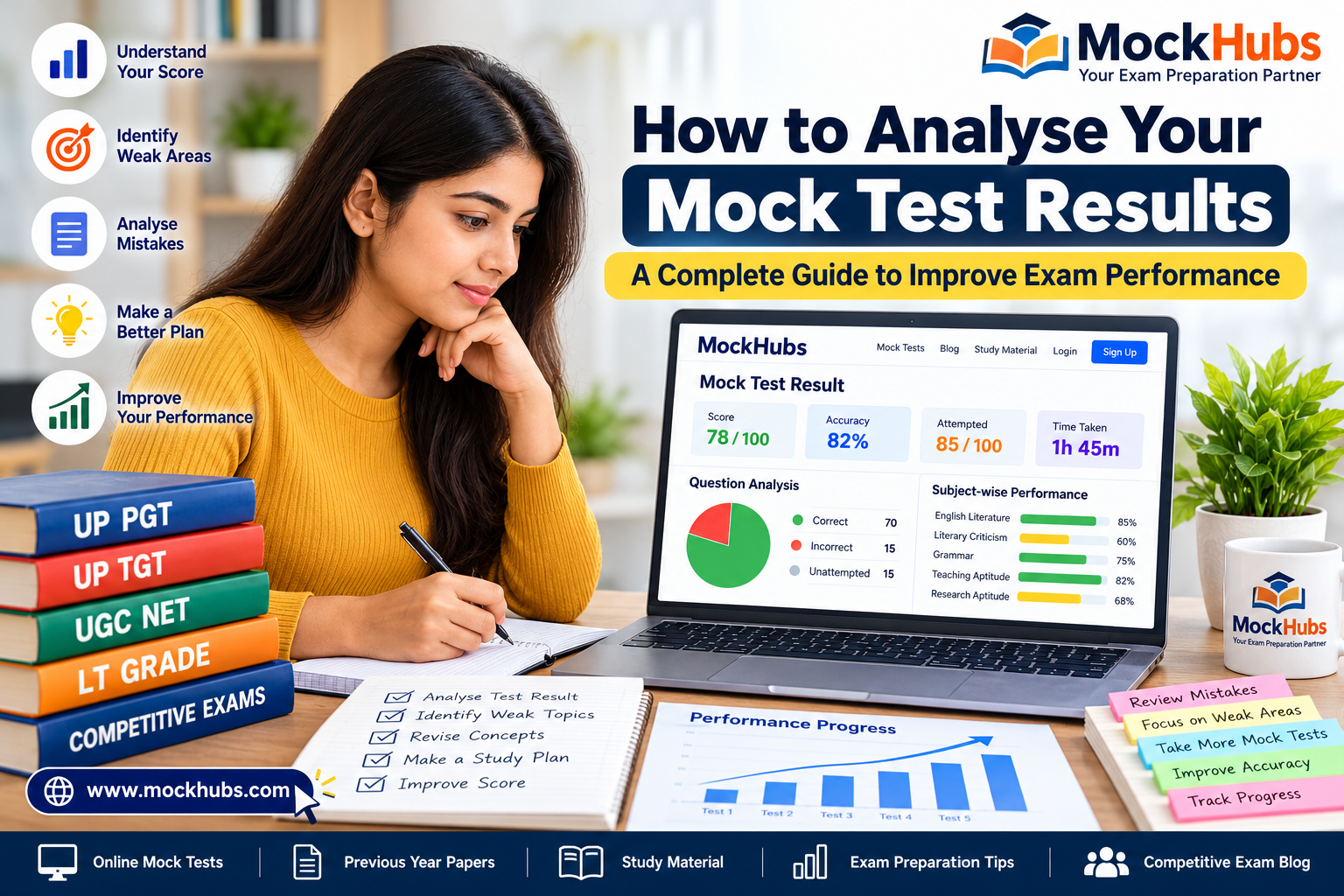
How to Analyse Your Mock Test Results: A Complete Guide to Improve Exam Performance
Preparing for competitive examinations requires more than reading books, memorising concepts and solving practice questions. One of the most important parts of successful exam preparation is analysing your mock test results.
Whether you are preparing for UP PGT, UP TGT, UP LT Grade, UGC NET, Assistant Professor or other competitive examinations, mock tests help you understand your preparation level and identify areas that need improvement.
However, simply attempting a mock test is not enough. You must analyse your performance, understand your mistakes and develop a better strategy for the next examination.
In this guide, we will explain how to analyse mock test results effectively and use your performance reports to improve your speed, accuracy and overall exam preparation.
1. Understand Your Overall Mock Test Score
The first step is to evaluate your overall performance.
After completing an online mock test, check the following:
Total questions attempted.
Total correct answers.
Total incorrect answers.
Unattempted questions.
Overall score.
Accuracy percentage.
Time taken to complete the test.
These metrics provide a basic understanding of your current preparation level.
For example:
| Performance Metric | Result |
|---|---|
| Total Questions | 100 |
| Attempted Questions | 80 |
| Correct Answers | 65 |
| Incorrect Answers | 15 |
| Unattempted Questions | 20 |
| Accuracy | 81.25% |
Do not judge your preparation only by your total score. Accuracy, question selection and time management are equally important.
2. Analyse Your Accuracy Percentage
Accuracy is one of the most important indicators of your exam preparation.
You can calculate accuracy using this formula:
Accuracy = (Correct Answers / Total Attempted Questions) × 100
For example:
If you attempt 80 questions and answer 65 correctly:
Accuracy = (65 / 80) × 100 = 81.25%
A higher accuracy percentage generally indicates better conceptual understanding and question-solving ability.
However, always consider the examination's negative marking system when evaluating your performance.
3. Identify Your Strong and Weak Subjects
Subject-wise analysis helps you understand which topics require more attention.
For example, if you are preparing for UP PGT English, divide your performance into different subject areas:
| Topic | Correct | Incorrect | Performance |
|---|---|---|---|
| British Literature | 18 | 2 | Strong |
| Literary Criticism | 10 | 8 | Needs Improvement |
| American Literature | 12 | 3 | Good |
| Literary Terms | 8 | 2 | Strong |
| Grammar | 7 | 8 | Weak |
Use this information to create a focused revision plan.
Spend more preparation time on weak topics while continuing to revise your strong areas.
4. Review Every Incorrect Answer
One of the biggest mistakes students make is checking their score and immediately moving to another mock test.
Instead, review every incorrect answer carefully.
Ask yourself:
Did I misunderstand the question?
Was my concept incorrect?
Did I forget an important fact?
Did I select an option without sufficient knowledge?
Did I make a careless mistake?
Write down the correct explanation for every important mistake.
This process helps prevent the same errors in future examinations.
5. Analyse Questions You Skipped
Unattempted questions also provide valuable information.
Sometimes students skip questions because:
They do not know the answer.
They are confused between two options.
They spend too much time on previous questions.
They are afraid of negative marking.
Review skipped questions to identify whether they were genuinely difficult or whether better time management could have helped.
6. Evaluate Your Time Management
Time management plays a crucial role in competitive examinations.
Check how much time you spent completing your mock test.
For example:
| Question Type | Time Spent |
|---|---|
| Easy Questions | 15 seconds |
| Moderate Questions | 40 seconds |
| Difficult Questions | 90 seconds |
If you spend too much time on difficult questions, you may miss easy questions later in the examination.
Practise a two-round strategy:
Round 1: Attempt easy and familiar questions.
Round 2: Return to difficult and time-consuming questions.
This approach helps you use examination time more effectively.
7. Maintain a Mock Test Performance Tracker
Maintaining a record of your mock test results helps you measure improvement over time.
Record the following information after every test:
Mock test name.
Date of examination.
Total score.
Accuracy percentage.
Attempted questions.
Incorrect answers.
Time taken.
Weak topics.
Improvement targets.
For example:
| Mock Test | Score | Accuracy |
|---|---|---|
| Test 1 | 48 | 65% |
| Test 2 | 55 | 72% |
| Test 3 | 62 | 78% |
| Test 4 | 70 | 84% |
This example shows how consistent practice and analysis can help improve performance.
Your actual progress will depend on test difficulty, syllabus coverage and preparation level.
8. Compare Your Previous Mock Test Results
Do not analyse every test independently.
Compare your recent performance with earlier mock tests.
Look for improvements in:
Overall score.
Accuracy percentage.
Question-solving speed.
Subject-wise performance.
Number of careless mistakes.
Confidence in answering difficult questions.
If your score is not improving, identify the reason before attempting more tests.
9. Focus on Conceptual Understanding
Repeatedly solving MCQs without understanding the concepts may limit your progress.
For every incorrect question:
Read the explanation.
Revise the related topic.
Understand why the other options are incorrect.
Solve similar questions.
Revisit the topic after a few days.
This approach develops long-term knowledge rather than temporary memorisation.
10. Set Improvement Targets for Your Next Mock Test
Every mock test should have a specific improvement target.
For example:
Improve accuracy from 70% to 80%.
Reduce unnecessary incorrect attempts.
Complete easy questions faster.
Improve performance in weak subjects.
Reduce time spent on difficult questions.
Set realistic targets based on your current performance.
11. Avoid Common Mock Test Analysis Mistakes
Many candidates attempt several mock tests but fail to improve because they do not analyse their performance properly.
Avoid these mistakes:
Focusing only on the final score.
Ignoring incorrect answers.
Not revising weak topics.
Attempting tests without a time limit.
Repeating the same mistakes.
Ignoring unattempted questions.
Comparing scores from tests with different difficulty levels without considering the difference.
Not maintaining a performance record.
12. Use Online Mock Tests for Continuous Improvement
Regular online mock test practice helps you understand the actual examination environment.
A dedicated practice platform can make your preparation more structured.
Visit MockHubs.com to explore online mock tests and exam preparation resources.
You can use MockHubs to support your preparation for competitive teaching examinations, practise MCQs and evaluate your subject knowledge.
Explore the platform and make mock test practice a regular part of your study routine.
13. Follow a Weekly Mock Test Analysis Routine
A weekly schedule can help you balance practice, revision and performance evaluation.
| Day | Activity |
|---|---|
| Monday | Topic-wise MCQ Practice |
| Tuesday | Subject-Wise Mock Test |
| Wednesday | Analyse Incorrect Answers |
| Thursday | Revise Weak Topics |
| Friday | Timed Practice Test |
| Saturday | Full-Length Mock Test |
| Sunday | Performance Analysis and Revision |
Adjust the schedule according to your examination date and syllabus.
Frequently Asked Questions (FAQs)
1. How should I analyse my mock test results?
Check your score, accuracy, incorrect answers, skipped questions, time management and subject-wise performance. Identify weak topics and prepare a revision plan.
2. How many mock tests should I attempt in a week?
The number depends on your preparation level. Beginners can start with one or two full-length tests per week, while advanced candidates may attempt more tests with sufficient time for analysis.
3. What is a good accuracy percentage in mock tests?
There is no universal target. Aim to improve your accuracy consistently while considering the actual examination's marking scheme and difficulty level.
4. Why are my mock test scores not improving?
Common reasons include insufficient revision, weak conceptual understanding, poor time management and repeating the same mistakes. Analyse your results to identify the actual problem.
5. Should I analyse every incorrect question?
Yes. Reviewing incorrect answers helps identify knowledge gaps, misunderstandings and careless mistakes.
6. Are online mock tests useful for UP PGT and UP TGT preparation?
Yes. Online mock tests help candidates practise exam-style questions, improve time management, identify weak areas and evaluate preparation progress.
7. Is mock test analysis more important than attempting more tests?
Both are important, but attempting more tests without analysing mistakes can limit improvement. Quality practice combined with detailed analysis is more effective.
Conclusion
Mock tests are not just a way to check your preparation level. They are an opportunity to understand your mistakes, improve weak areas and develop an effective examination strategy.
Remember that every mock test should teach you something new.
Analyse your performance, revise difficult concepts, track your progress and work consistently towards your target score.
Start your exam preparation with MockHubs!
Visit https://mockhubs.com/ to explore mock tests and preparation resources. Practise regularly, analyse your results and move one step closer to your competitive examination goals.
Put this into practice
Take a full-length, exam-pattern mock test in English or Hindi and see your topic-wise report in minutes.
Take a free mock test Browse exams