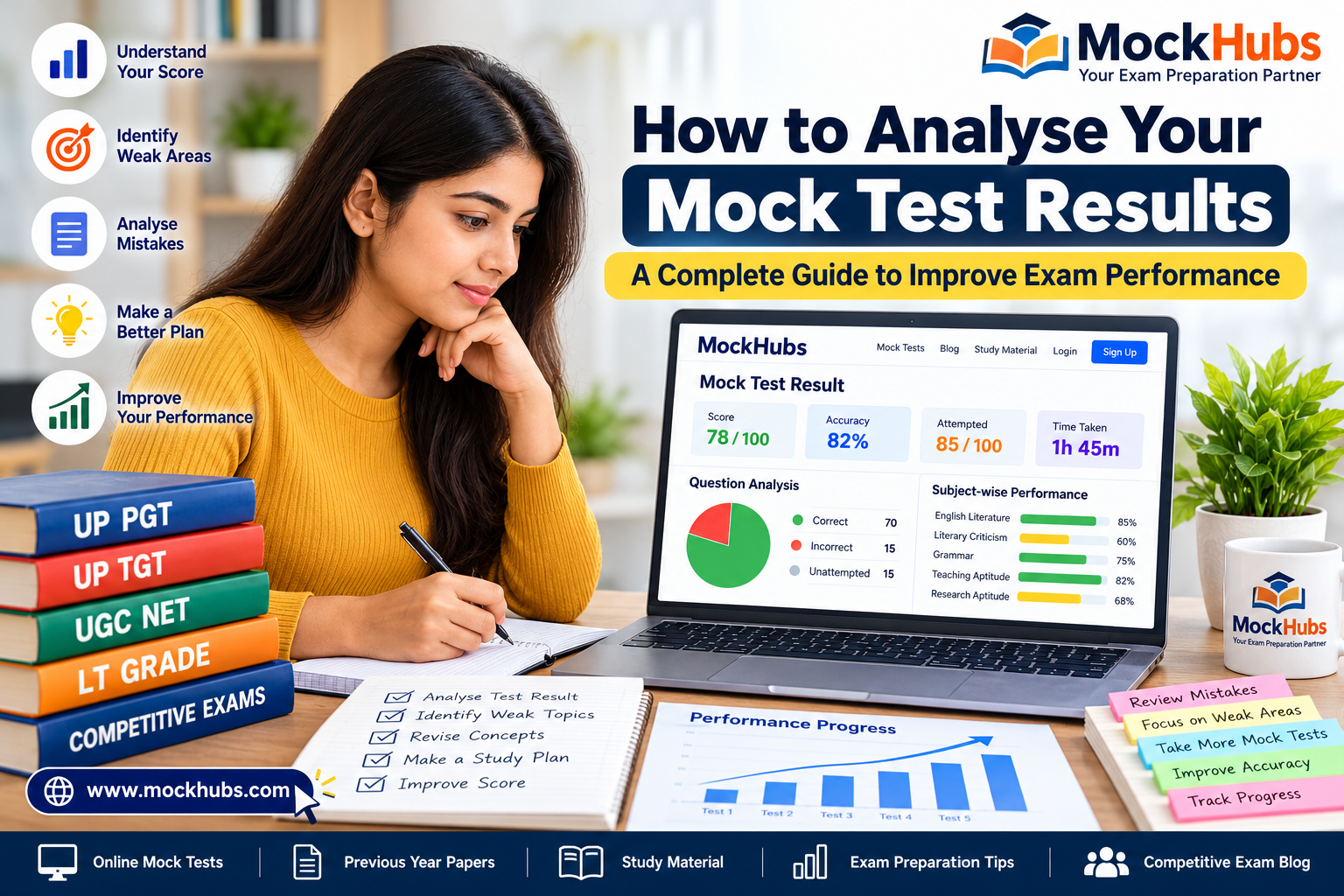
How to Make an Effective Revision Timetable
How to Make an Effective Revision Timetable: A Complete Guide for Competitive Exam Preparation Preparing for competitive examinations requires proper planning, regular practice and effective revision. Many students…

How to Make an Effective Revision Timetable: A Complete Guide for Competitive Exam Preparation
Preparing for competitive examinations requires proper planning, regular practice and effective revision. Many students spend several hours studying every day but still struggle to remember important concepts during examinations.
The main reason is often the absence of a proper revision strategy.
Whether you are preparing for UP PGT, UP TGT, UP LT Grade, UGC NET, Assistant Professor or other competitive examinations, an effective revision timetable can help you organise your studies, improve memory retention and build confidence.
A well-planned timetable ensures that you cover the complete syllabus, revise important topics regularly and get sufficient time for mock tests and practice questions.
In this guide, we will explain how to create an effective revision timetable, manage study time and improve your preparation for competitive examinations.
1. Understand Your Complete Syllabus
Before creating a revision timetable, understand your examination syllabus.
Divide your syllabus into smaller subjects and topics.
For example, UP PGT English candidates can organise their syllabus into:
History of English Literature
British Literature
American Literature
Indian Writing in English
Literary Criticism
Literary Theory
Poetry and Drama
Grammar and Linguistics
Literary Terms
Make a checklist of all topics and identify which ones you have completed, partially prepared or not started.
This will help you allocate study time according to your preparation level.
2. Set Clear Study Goals
Do not create a timetable without defining your daily and weekly goals.
Your goals should be specific, measurable and realistic.
For example:
Daily Goals
Revise two important topics.
Solve 50 MCQs.
Read important notes for 30 minutes.
Practise one topic-wise test.
Review incorrect answers.
Weekly Goals
Complete one major syllabus section.
Attempt two mock tests.
Revise previously studied topics.
Analyse weak areas.
Update your preparation progress.
Clear goals make your preparation more organised.
3. Divide Your Study Time Properly
Avoid spending your entire study session on one subject.
Allocate time to different activities, including concept revision, MCQ practice, mock tests and mistake analysis.
Here is an example of a daily study timetable for a student who can dedicate approximately six hours to preparation.
| Time | Activity |
|---|---|
| 7:00 AM – 8:00 AM | Revision of Previous Topics |
| 8:00 AM – 9:00 AM | New Topic Preparation |
| 10:00 AM – 11:00 AM | Subject-Wise MCQ Practice |
| 11:00 AM – 12:00 PM | Important Notes and Concepts |
| 4:00 PM – 5:00 PM | Online Mock Test |
| 5:00 PM – 6:00 PM | Mock Test Analysis |
Adjust the timetable according to your personal routine and examination requirements.
4. Follow the 3-Step Revision Strategy
An effective revision timetable should include three important stages.
First Revision: Understand the Concepts
Revise the topic immediately after completing it.
Focus on understanding definitions, theories, important facts and examples.
Second Revision: Strengthen Your Memory
Revisit the same topic after a few days.
Use short notes, flashcards, timelines and practice questions.
Third Revision: Test Your Knowledge
Attempt MCQs and mock tests based on the revised topic.
This helps identify whether you can recall and apply the information correctly.
5. Use the Spaced Repetition Technique
Spaced repetition is a learning technique in which you revise information at increasing intervals.
Instead of studying a topic only once, revisit it regularly.
For example:
| Revision Stage | Suggested Time |
|---|---|
| First Revision | Same Day |
| Second Revision | After 1 Day |
| Third Revision | After 3 Days |
| Fourth Revision | After 7 Days |
| Fifth Revision | After 15 Days |
| Sixth Revision | After 30 Days |
These are suggested intervals. Adjust them according to how easily you remember each topic.
Regular revision can help improve long-term retention.
6. Give More Time to Weak Subjects
Not every subject requires equal preparation time.
Some topics may already be strong, while others may require additional revision.
For example, if you are preparing for UP PGT English:
| Subject | Preparation Level | Priority |
|---|---|---|
| British Literature | Strong | Medium |
| Literary Criticism | Weak | High |
| American Literature | Average | Medium |
| Literary Terms | Strong | Low |
| Grammar | Weak | High |
Spend more time on subjects where your performance is weak.
However, continue revising strong topics to maintain your knowledge.
7. Include Daily MCQ Practice
Reading notes alone is not enough for competitive examination preparation.
You should regularly solve multiple-choice questions to evaluate your understanding.
Daily MCQ practice helps you:
Improve question-solving speed.
Increase answer accuracy.
Understand question patterns.
Identify weak topics.
Develop confidence.
Visit MockHubs.com to explore online mock tests and competitive exam preparation resources.
Include topic-wise MCQ practice in your daily revision timetable.
8. Schedule Weekly Mock Tests
Mock tests should be an important part of your revision plan.
Attempting mock tests helps you understand how well you can apply your knowledge under examination conditions.
A sample weekly schedule:
| Day | Activity |
|---|---|
| Monday | Subject Revision |
| Tuesday | Topic-Wise MCQ Practice |
| Wednesday | Weak Topic Revision |
| Thursday | Subject-Wise Mock Test |
| Friday | Previous Year Questions |
| Saturday | Full-Length Mock Test |
| Sunday | Mock Test Analysis and Revision |
Remember that analysing your mock test performance is just as important as attempting the test.
9. Prepare Short Revision Notes
Short notes are extremely useful during the final stages of examination preparation.
Avoid writing lengthy explanations again and again.
Instead, prepare concise notes containing:
Important dates and events.
Author names and literary works.
Important definitions.
Theories and concepts.
Formulas and facts.
Frequently asked questions.
For English Literature, prepare author-wise and literary-period-wise revision charts.
These notes will save time during your final revision.
10. Include Previous Year Question Papers
Previous year question papers help you understand the examination pattern and commonly tested topics.
Include PYQ practice in your weekly timetable.
While solving previous year questions:
Attempt questions within a time limit.
Identify frequently tested topics.
Review incorrect answers.
Revise related concepts.
Maintain a separate notebook for important questions.
Do not rely only on previous year questions. Use them alongside complete syllabus preparation.
11. Avoid Common Revision Timetable Mistakes
Many students create impressive study schedules but struggle to follow them consistently.
Avoid these common mistakes:
Creating unrealistic daily study targets.
Ignoring weak subjects.
Studying without taking breaks.
Not including mock tests.
Revising topics only once.
Ignoring previous year questions.
Spending too much time making notes.
Not tracking daily progress.
Changing the timetable frequently.
Studying without proper sleep and rest.
Your timetable should be practical and flexible.
12. Use a 30-Day Revision Plan
If your examination is approaching, follow a structured 30-day revision strategy.
| Period | Main Focus |
|---|---|
| Days 1–7 | Revise Important Concepts |
| Days 8–14 | Subject-Wise Revision and MCQs |
| Days 15–21 | Mock Tests and Weak Topics |
| Days 22–26 | Previous Year Papers and Important Notes |
| Days 27–30 | Final Revision and Practice Tests |
Adjust this plan according to your syllabus completion and examination date.
13. Track Your Daily Study Progress
A timetable becomes more effective when you regularly monitor your progress.
Maintain a daily checklist containing:
Topics completed.
Topics revised.
MCQs attempted.
Mock tests completed.
Accuracy percentage.
Weak topics identified.
Pending revision tasks.
Review your progress every week and make changes wherever necessary.
Sample Revision Timetable for Competitive Exams
Here is a practical daily revision structure that students can customise.
| Study Activity | Suggested Time |
|---|---|
| Previous Topic Revision | 45 Minutes |
| Main Subject Preparation | 90 Minutes |
| Short Break | 15 Minutes |
| MCQ Practice | 45 Minutes |
| Weak Topic Revision | 60 Minutes |
| Mock Test Practice | 60 Minutes |
| Performance Analysis | 30 Minutes |
The total study time is approximately 5 hours and 15 minutes, excluding the break.
You can increase or reduce study time according to your availability.
Frequently Asked Questions (FAQs)
1. How do I make an effective revision timetable for competitive exams?
Start by understanding your syllabus, dividing subjects into smaller topics, setting daily goals and allocating time for revision, MCQ practice and mock tests.
2. How many hours should I study daily for competitive exams?
Study time depends on your preparation level, syllabus and examination date. Focus on consistent, productive study rather than simply counting hours.
3. How often should I revise a topic?
You can follow a spaced revision schedule, such as same-day revision followed by revisions after 1, 3, 7, 15 and 30 days.
4. How can I manage multiple subjects in one timetable?
Divide your study sessions between different subjects. Give additional time to weak areas while regularly revising strong subjects.
5. Should I attempt mock tests during revision?
Yes. Mock tests help evaluate your preparation, identify knowledge gaps and improve time management.
6. What is the best revision strategy for UP PGT and UP TGT?
Focus on complete syllabus coverage, short notes, subject-wise MCQs, previous year questions and regular full-length mock tests.
7. How can I complete my revision in 30 days?
Prioritise important topics, revise short notes, practise MCQs daily, attempt mock tests and spend the final days reviewing weak areas.
Conclusion
An effective revision timetable is an essential part of competitive exam preparation.
It helps you organise your study sessions, revise important concepts, improve memory retention and evaluate your preparation through regular practice.
Remember that consistency is more important than following a complicated timetable.
Set realistic goals, revise regularly, practise MCQs and analyse your mock test performance.
Start your preparation today with MockHubs!
Visit MockHubs.com to explore online mock tests and exam preparation resources. Build a consistent revision routine, evaluate your progress and move closer to achieving your competitive examination goals.
Put this into practice
Take a full-length, exam-pattern mock test in English or Hindi and see your topic-wise report in minutes.
Take a free mock test Browse exams