How to Improve Your MCQ Solving Speed
Learn how to improve MCQ solving speed with 15 proven techniques for competitive exams. Discover time management, accuracy tips and mock test strategies.
How to Improve Your MCQ Solving Speed: 15 Proven Tips for Competitive Exams
Solving Multiple Choice Questions (MCQs) quickly and accurately is one of the most important skills for competitive exam preparation. Whether you are preparing for UP PGT, UP TGT, LT Grade, UGC NET, Assistant Professor or other teaching examinations, managing your time effectively can make a significant difference in your final score.
Many students know the correct answers but struggle to complete the paper within the given time. The main reason is not always a lack of knowledge; sometimes it is poor time management, overthinking, slow reading or an ineffective question-solving strategy.
In this guide, we will discuss 15 practical techniques to improve your MCQ solving speed without compromising accuracy.
1. Understand the Exam Pattern First
Before starting your preparation, understand the examination pattern carefully.
Check the following details:
Total number of questions.
Total examination duration.
Marks awarded for each correct answer.
Negative marking rules.
Subject-wise question distribution.
Difficulty level of previous year papers.
Understanding the exam pattern helps you decide how much time to spend on each question.
2. Follow the 30-Second Rule
Develop the habit of solving straightforward MCQs within approximately 30 seconds.
If a question requires more time, mark it for review and move to the next question.
Remember:
Easy questions: 10–20 seconds.
Moderate questions: 20–45 seconds.
Difficult questions: Review later.
These are practice targets, not fixed rules for every examination.
3. Read Questions Carefully
Reading questions too quickly can lead to careless mistakes.
Pay special attention to words such as:
NOT
EXCEPT
INCORRECT
CORRECT
MOST APPROPRIATE
ALL OF THE ABOVE
Underline or mentally highlight important keywords before selecting an answer.
4. Eliminate Incorrect Options
You do not always need to know the correct answer immediately.
Sometimes, eliminating incorrect options makes the answer easier to identify.
For example:
Question: Who wrote Paradise Lost?
A. William Shakespeare
B. John Milton
C. Geoffrey Chaucer
D. John Keats
By eliminating unrelated authors, you can quickly identify the correct answer.
Correct Answer: B. John Milton
Practise option elimination regularly to improve your decision-making speed.
5. Practise Topic-Wise MCQs Daily
Do not depend only on reading books and notes.
Solve topic-wise MCQs every day to improve your familiarity with different question patterns.
For example, UP PGT English aspirants can practise:
History of English Literature
Literary Criticism
British Poetry
British Drama
American Literature
Literary Terms
Grammar and Linguistics
Regular practice reduces the time required to understand familiar question patterns.
6. Use the Two-Round Strategy
One of the most effective examination techniques is solving the paper in two rounds.
Round 1:
Attempt questions you know confidently.
Avoid spending too much time on difficult questions.
Mark doubtful questions for review.
Round 2:
Return to unanswered questions.
Apply elimination techniques.
Spend the remaining time on challenging questions.
This strategy ensures that you do not lose easy marks because of a few difficult questions.
7. Improve Your Reading Speed
Reading speed directly affects MCQ solving speed.
To improve reading efficiency:
Read English and subject-related material daily.
Practise identifying keywords.
Avoid reading every sentence repeatedly.
Develop familiarity with important terminology.
Practise comprehension questions with a timer.
8. Learn Important Facts and Concepts
Memorising random answers is not an effective long-term strategy.
Focus on understanding concepts, important facts, dates, authors, books, theories and definitions.
For English literature aspirants, prepare revision charts for:
Literary periods and their timelines.
Major writers and their works.
Literary movements.
Important literary critics.
Famous quotations and literary terms.
Well-organised revision notes help you recall answers faster.
9. Avoid Overthinking
Overthinking is a common reason for losing valuable examination time.
If you have understood the question and identified a reliable answer, avoid changing it repeatedly without a valid reason.
Build confidence through regular timed practice rather than random guessing.
10. Practise with a Timer
Solving MCQs without a timer does not prepare you fully for the actual examination.
Start with a comfortable time limit and gradually reduce it.
For example:
| Practice Level | Questions | Target Time |
|---|---|---|
| Beginner | 20 | 20 minutes |
| Intermediate | 30 | 25 minutes |
| Advanced | 50 | 35 minutes |
| Expert | 100 | 60 minutes |
Adjust these targets according to your actual examination pattern and question difficulty.
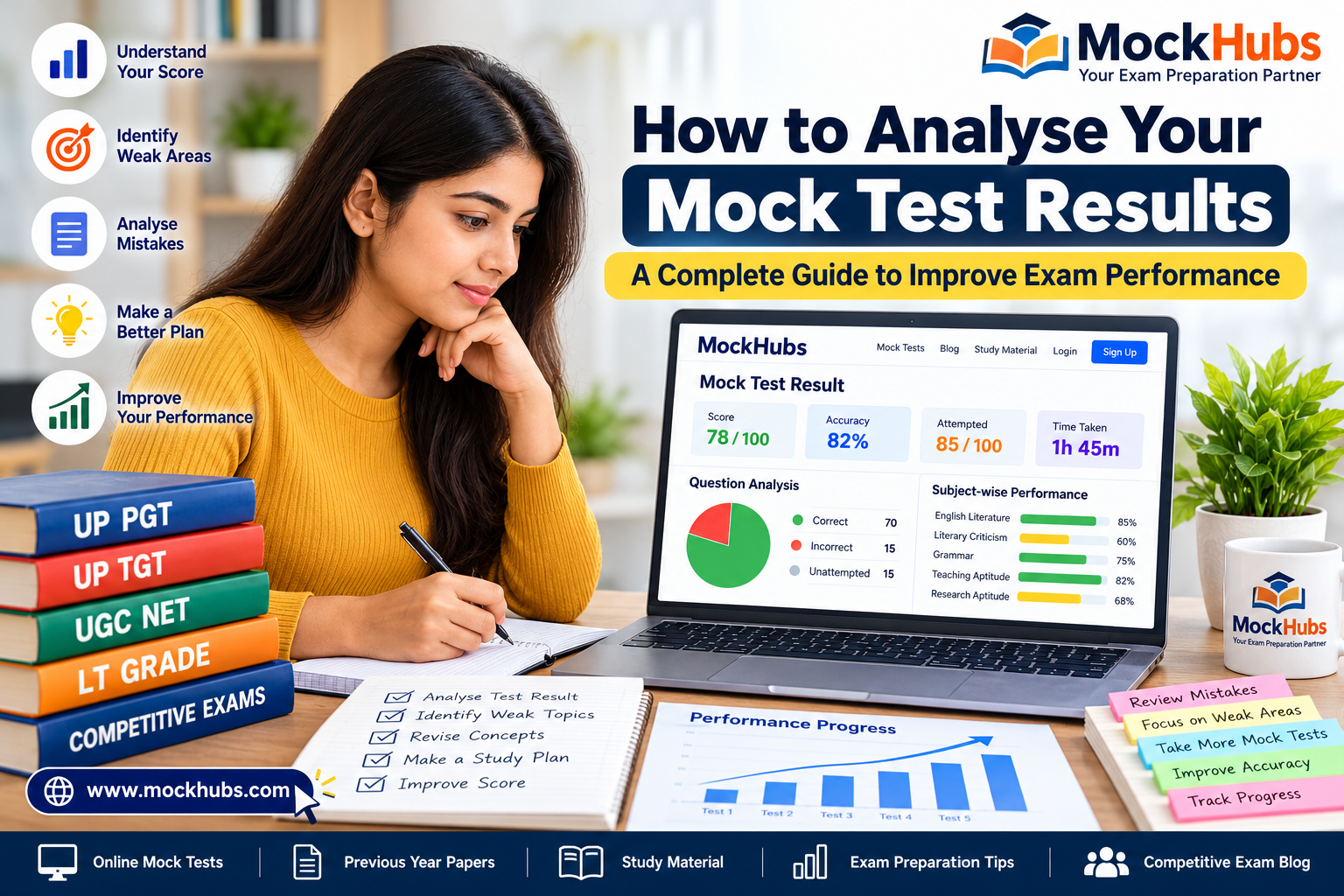
11. Analyse Every Mock Test
Attempting mock tests is important, but analysing your performance is equally important.
After completing each test, identify:
Questions answered incorrectly.
Questions skipped unnecessarily.
Questions that consumed too much time.
Topics where accuracy is low.
Questions answered correctly through guessing.
Maintain an error notebook and revise your mistakes regularly.
12. Improve Your Accuracy Along with Speed
Solving questions quickly is useful only when your answers are accurate.
Follow these principles:
Avoid blind guessing.
Understand negative marking rules.
Revise frequently asked concepts.
Identify your weak topics.
Practise similar questions repeatedly.
Your goal should be to improve both speed and accuracy.
13. Develop a Smart Guessing Strategy
When you are unsure about an answer, eliminate options that are clearly incorrect.
However, guessing should depend on the examination's negative marking rules.
If there is no negative marking, attempting every question may be beneficial. If negative marking applies, make informed decisions based on your confidence and the marking scheme.
14. Build a Daily MCQ Practice Routine
Consistency is more important than solving hundreds of questions occasionally.
A simple daily routine:
| Activity | Time |
|---|---|
| Concept Revision | 30 minutes |
| Topic-wise MCQs | 30 minutes |
| Timed Practice | 20 minutes |
| Mock Test Analysis | 20 minutes |
| Mistake Revision | 10 minutes |
Follow this routine regularly and adjust it according to your syllabus and preparation level.
15. Use Online Mock Tests for Real Exam Practice
Online mock tests help you become comfortable with computer-based examinations.
They also help you:
Improve question-solving speed.
Develop time management skills.
Understand your accuracy level.
Identify weak subjects.
Reduce examination anxiety.
Monitor preparation progress.
Practise regularly with subject-wise and full-length mock tests.
Common Mistakes to Avoid While Solving MCQs
Spending too much time on a single question.
Reading questions without understanding keywords.
Changing answers repeatedly.
Ignoring negative marking.
Practising without a timer.
Not analysing incorrect answers.
Memorising answers without understanding concepts.
Ignoring previous year question papers.
Frequently Asked Questions (FAQs)
1. How can I solve MCQs faster in competitive exams?
Practise timed tests, learn option elimination, improve reading speed and follow a two-round question-solving strategy.
2. How many seconds should I spend on one MCQ?
For straightforward questions, aim for approximately 20–30 seconds. However, the ideal time depends on the examination pattern and difficulty level.
3. How can I improve MCQ accuracy?
Focus on conceptual clarity, regular revision, previous year questions and detailed mock test analysis.
4. Is solving 100 MCQs daily enough for competitive exams?
Solving 100 MCQs can be useful, but quality matters more than quantity. Understand your mistakes and revise the concepts behind incorrect answers.
5. Are online mock tests helpful for UP PGT and UP TGT preparation?
Yes. Online mock tests help candidates practise exam-style questions, manage time, identify weak areas and evaluate their preparation.
6. Should I attempt difficult questions first?
Generally, no. Attempt easier and familiar questions first, then return to difficult questions if time permits.
Conclusion
Improving MCQ solving speed requires consistent practice, subject knowledge, effective time management and a smart examination strategy.
Do not focus only on solving more questions. Focus on solving questions correctly within a reasonable time.
Start practising daily, analyse your mock test performance and gradually improve your speed and accuracy.
Ready to improve your MCQ solving skills?
Visit MockHubs.com and practise online mock tests to evaluate your preparation, identify weak areas and build confidence for your upcoming competitive examinations.
Put this into practice
Take a full-length, exam-pattern mock test in English or Hindi and see your topic-wise report in minutes.
Take a free mock test Browse exams